Get the latest Science News and Discoveries
For The First Time Ever, Astronomers Watched a Giant Planet Disappear. Now They Think They Know Why.
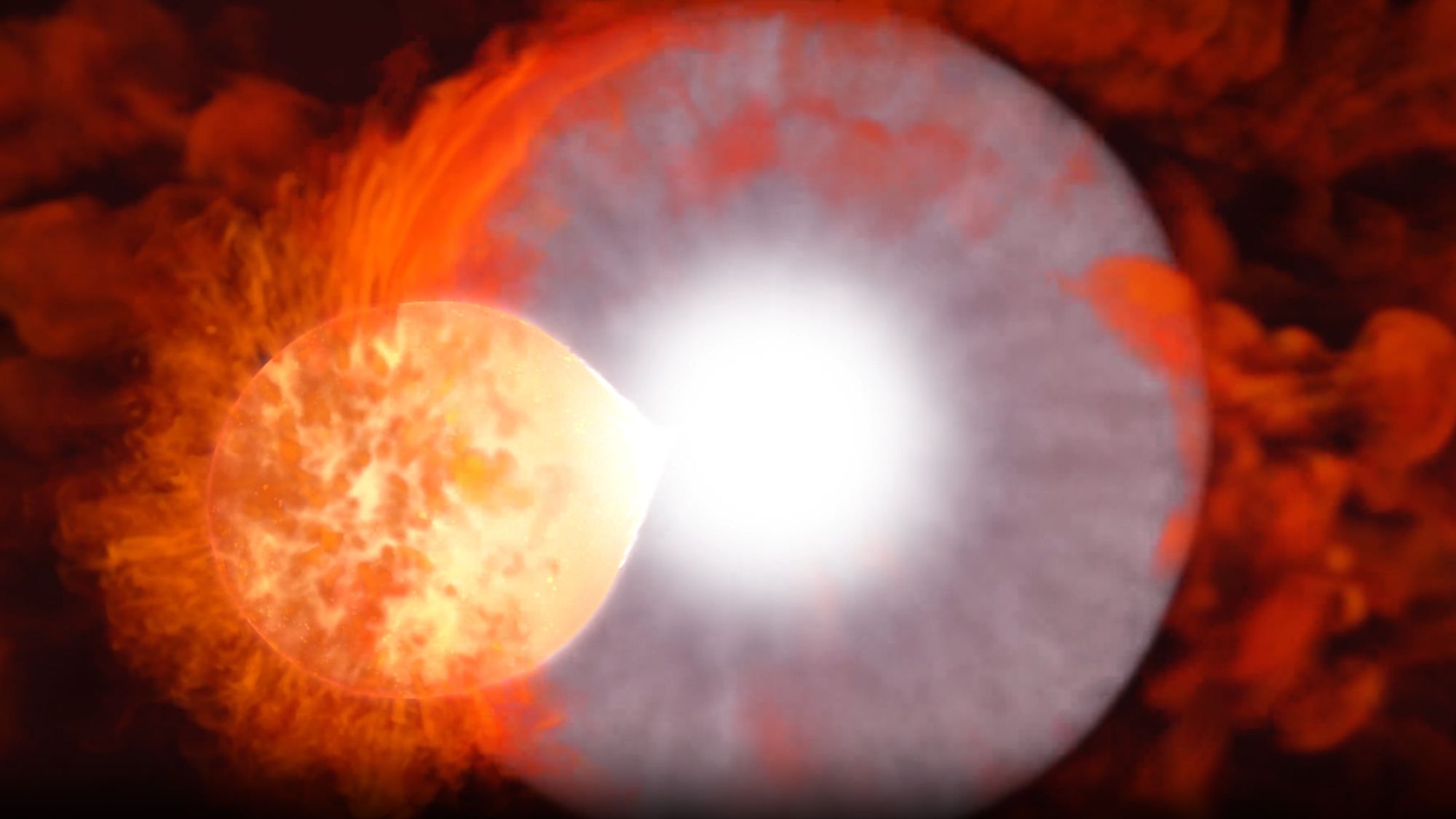
Discovering alien worlds around distant stars is hugely skill-reliant but also part cosmic lottery. One has to look from the right perspective, at a specific star, at the right time to catch a fleeting glimpse of an exoplanet. In a stroke of serendipity, astronomers have now observed an exoplanet do something they'd never seen before – it disappeared. Planets don't usually disappear, so was this an observational fluke, perhaps suggesting that another telescope needs eyeglasses, as Hubble did in 1993? Was it evidence of a real Death Star erasing an exoplanet from existence? The real reason is just as exciting, and its unprecedented vanishing trick is described in a paper recently published in The Astrophysical Journal Letters. The exoplanet in question, called TOI-2535b, has a hidden companion, and these two planetary siblings are gravitationally nudging each other into a complex orbital shuffle around their stellar parent, named TOI-2535, a 9.7 billion-year-old K dwarf star slightly smaller than the Sun and located roughly 1,100 light-years away. The K dwarf is known to host this "hot Jupiter" TOI-2535b, which may be about the mass of our cold Jupiter but spirals so close to its star that it completes an orbit in just over eight days - 10 times more quickly than our innermost planet, Mercury.
None
Or read this on Science Alert