Nobel Prize

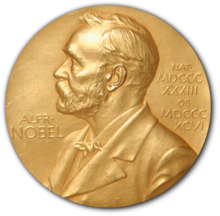
The Nobel Prizes ( noh-BEL; Swedish: Nobelpriset [nʊˈbɛ̂lːˌpriːsɛt]; Norwegian: Nobelprisen [nʊˈbɛ̀lːˌpriːsn̩]) are five separate prizes that, according to Alfred Nobel's will of 1895, are awarded to "those who, during the preceding year, have conferred the greatest benefit to humankind." Alfred Nobel was a Swedish chemist, engineer, and industrialist most famously known for the invention of dynamite.
Read more in the app

To Win A Nobel Prize, Go To The Ends Of The Earth

Life Is Asymmetric. The Scientists Who Figured Out Why Won the 2026 Nobel Prize in Chemistry

A Scientist Working on the ‘IceCube’ Neutrino Detector Explains the Nobel Prize–Winning Technology

Nobel Prize in Chemistry Is Awarded to Henri Kagan and Kenso Soai

Nobel prize in chemistry awarded for work on mirror molecules

Nobel Prize honors researchers who showed how ‘handedness’ can emerge in chemistry

Nobel Prize in Physics Is Awarded to Francis Halzen for Work on Neutrinos

Nobel prize in physics awarded for discovery of high-energy neutrinos

Astronomy’s ‘adrenaline junkies’: Nobel prize captures the thrill of neutrino physics

Nobel Prize in Physiology or Medicine Is Awarded for Discoveries in Neuroscience

Nobel prize for medicine goes to trio who developed optogenetics

Six biology breakthroughs that should have won a Nobel Prize—but didn’t

Can you name the women who have won a science Nobel prize?

Five physics breakthroughs that should have won a Nobel Prize—but didn’t

He Won the Nobel Prize for Protein Design. Now He Uses AI to Create Molecules Not Found in Nature

X-rays: beyond the Nobel Prize limit - EurekAlert!

Toward experiment-guided AlphaFold: ISTA researchers enhance Nobel Prize-winning AI tool - EurekAlert!

J. Michael Bishop, Nobel Prize Winner for Cancer Research, Dies at 90

Computer science’s ‘Nobel Prize’ goes quantum

For the first time, light mimics a Nobel Prize quantum effect